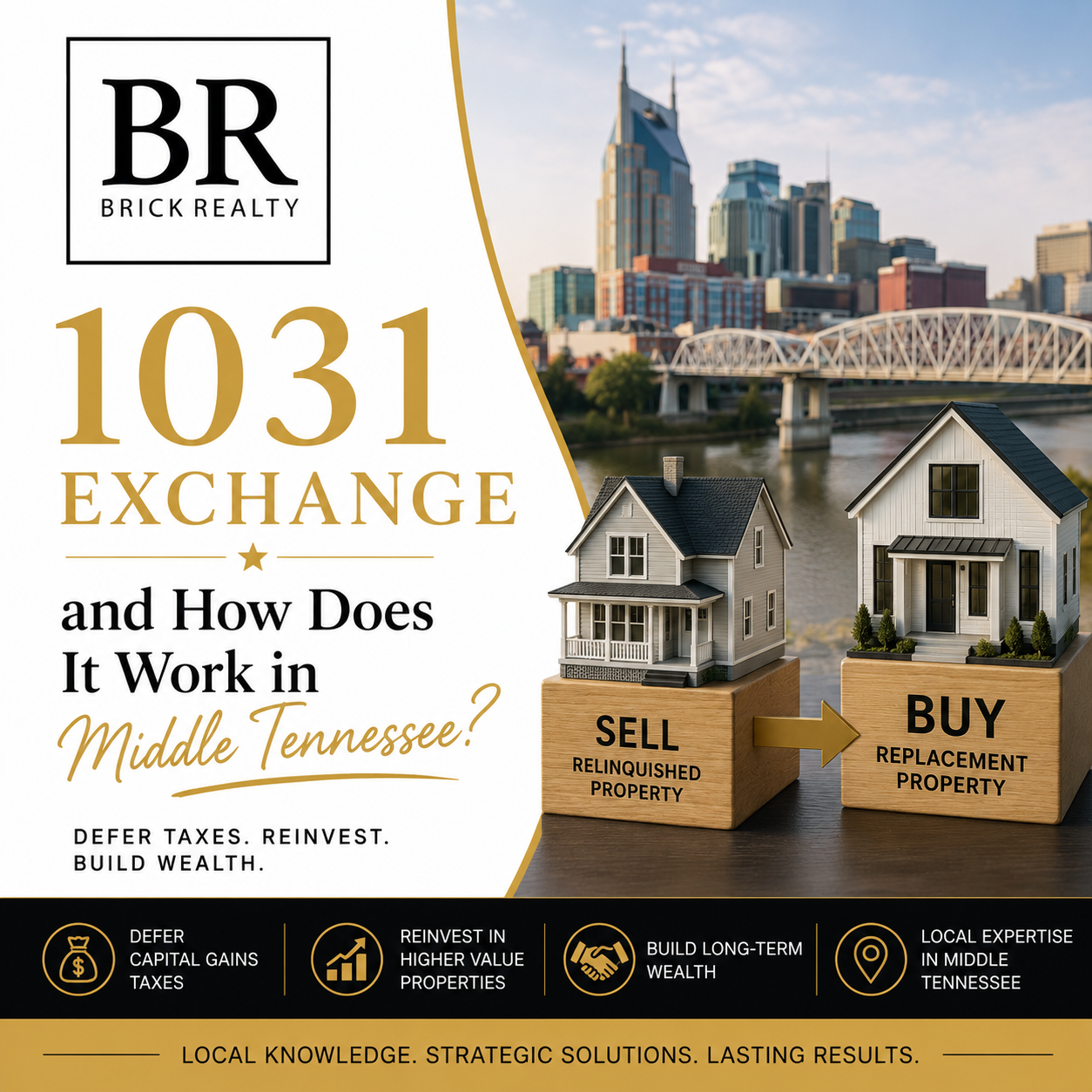
What Is a 1031 Exchange and How Does It Work in Middle Tennessee?
TL;DR: The quick summary
A 1031 exchange lets real estate investors sell an investment or business property and reinvest the proceeds into another qualifying property while deferring capital gains taxes. In a high-growth region like Middle Tennessee, where prices span from the affordable $400,000s in Rutherford and Maury counties to over $1 million in Williamson County, this strategy can help investors trade up, diversify, or reposition across the Nashville metro without an immediate tax bill. The rules are strict, with a 45-day window to identify a replacement property and 180 days to close, so working with a qualified intermediary and your tax professional is essential.
## What Is a 1031 Exchange?
A 1031 exchange, named for Section 1031 of the Internal Revenue Code, allows an investor to sell one investment or business property and reinvest the proceeds into a "like-kind" replacement property while deferring the capital gains taxes that would normally be due on the sale.
The word "exchange" is important. Instead of simply selling one property and buying another, the transaction is structured so that the proceeds never touch your hands. A qualified intermediary holds the funds and applies them to the purchase of the replacement property, which keeps the deferral intact.
Since the Tax Cuts and Jobs Act of 2017, 1031 exchanges apply only to real property held for productive use in a trade, business, or investment. Personal property no longer qualifies. The good news for investors is that almost any U.S. real estate is considered like-kind to any other real estate, so a rental home in Franklin can be exchanged for a small commercial building, raw land, or a larger multifamily property anywhere across Middle Tennessee or beyond.
## Why 1031 Exchanges Matter for Middle Tennessee Investors
Middle Tennessee has been one of the fastest growing regions in the country, and home prices across the Nashville metro have climbed substantially over the past several years. The broader nine-county region now carries a median sale price in the neighborhood of $500,000, while Williamson County, home to Franklin and Brentwood, sits at the high end near $1.1 million based on recent Realtracs data. Counties like Rutherford, home to Murfreesboro, and Maury, home to Columbia, offer more affordable entry points in the $400,000s.
For investors who bought rental or income property years ago, that appreciation often translates into a large embedded gain. When you sell an appreciated investment property outright, federal capital gains tax, depreciation recapture, the net investment income tax, and applicable state taxes can combine to take a meaningful share of your profit. A 1031 exchange lets you defer those taxes and keep more of your equity working in the next property.
That deferral opens up strategic options across the region. Because like-kind is defined broadly for real estate, you can sell a rental in one county and reinvest in another. A Franklin investor might trade a single rental in McKays Mill or Fieldstone Farms into a larger multifamily property in Nashville. A Nashville owner might diversify into new construction near Berry Farms or Cool Springs. Investors also move into growing submarkets like Mount Juliet in Wilson County, Spring Hill along the Williamson and Maury line, or Hendersonville in Sumner County.
In July 2025, the One Big Beautiful Bill Act preserved Section 1031 exchanges fully intact for real estate, so this remains a reliable planning tool for investors across Franklin, Brentwood, Nashville, Murfreesboro, and the rest of Middle Tennessee.
## The Main Types of 1031 Exchanges
Most investors picture a simple swap, but a 1031 exchange can be structured a few different ways depending on your timing and goals.
**Delayed exchange** (also called a forward exchange) is the standard and most common structure. You sell your relinquished property first, a qualified intermediary holds the proceeds, and you then identify and purchase your replacement property within the 45- and 180-day windows.
**Reverse exchange** is the opposite order. You acquire the replacement property before selling your existing one. Because IRS rules do not allow you to hold title to both properties at the same time, an Exchange Accommodation Titleholder (EAT) temporarily holds title to one of the properties until the sale is complete. Reverse exchanges are more complex and more costly, but they can be valuable in a competitive market like Middle Tennessee, where the right replacement property may come along before you have sold.
**Improvement exchange** (also called a build-to-suit or construction exchange) lets you use exchange funds to build on or renovate the replacement property. An EAT holds title while the improvements are made, and only the value of improvements actually completed within the 180-day window counts toward the exchange.
Most Middle Tennessee investors use a straightforward delayed exchange, but reverse and improvement structures can be powerful tools when the timing or the property calls for them. These advanced structures require early coordination with an experienced qualified intermediary.
## The 1031 Exchange Rules and Timeline
The 1031 exchange runs on two strict, concurrent deadlines that both begin the day your original property - called the relinquished property - closes.
**The 45-day identification period** is the window to identify your replacement property or properties in writing. The identification must be unambiguous, signed by you, and delivered to your qualified intermediary before midnight on the 45th day.
**The 180-day exchange period** is the window to actually close on the replacement property. This clock runs at the same time as the 45-day clock, which means if you use all 45 days to identify, you have 135 days left to close.
Both deadlines are firm. The IRS does not grant extensions, and they are not pushed back for weekends or holidays. Missing either deadline can void the entire exchange and trigger the full tax bill.
When identifying replacement properties, investors typically use one of three rules: the **three-property rule** (up to three properties of any value), the **200 percent rule** (any number of properties as long as their combined value does not exceed 200 percent of the sold property), or the **95 percent rule**.
To defer 100 percent of the tax, the general expectation is to reinvest all of your equity and replace your debt, with the replacement property costing at least as much as the net sale price of what you sold. Any shortfall, known as "boot," becomes taxable.
## What Property Qualifies - and What Does Not - in Middle Tennessee
Not every property is eligible, and this is where local investors most often get tripped up.
Qualifying property must be held for investment or business use. That includes rental homes across Franklin and Nashville, small apartment buildings in Murfreesboro, commercial space near Cool Springs, and vacant land held for investment anywhere in the region.
Your primary residence does not qualify for a 1031 exchange, because it is not held for investment or business. A home you live in may instead qualify for the Section 121 home sale exclusion, which is a separate tax provision with its own rules. Mixed-use properties - such as a home with a rental unit - can sometimes have a qualifying portion, but that requires careful analysis.
Because the definition of like-kind is broad for real estate, Middle Tennessee investors have real flexibility. A rental near Historic Downtown Franklin can be exchanged for property in Wilson County, Sumner County, or another state entirely, as long as both are qualifying investment real estate.
The most important early step is confirming eligibility with a qualified tax professional before you list, so the transaction is structured correctly from day one.
## Common Mistakes Middle Tennessee Investors Make With 1031 Exchanges
The most frequent and costly mistake is taking possession of the sale proceeds. If the money passes through your hands rather than through a qualified intermediary, the exchange is disqualified.
Another common misstep is waiting too long to line up a replacement property. In a competitive market like the Nashville metro, suitable investment properties can move quickly, and the 45-day identification clock is unforgiving. Many experienced investors identify potential replacements before they even list the relinquished property, and some use a reverse exchange to lock in the new property first.
Other pitfalls include trying to exchange a primary residence, missing a deadline by even a single day, failing to replace debt and equity fully, and working with an intermediary who is not truly independent. Verbal identifications do not count, and the paperwork has to be precise.
The best defense is assembling your team early: a qualified intermediary, a CPA or tax advisor, a real estate attorney when needed, and a local agent who understands the Middle Tennessee investment landscape.
## Let's Talk About Your Middle Tennessee Investment Strategy
A 1031 exchange can be a powerful way to grow and reshape your real estate portfolio in one of the country's strongest markets, but the rules are strict and the timing is unforgiving. The investors who benefit most are the ones who plan early and build the right team around them.
As a local Franklin REALTOR® with Brick Realty, I help buyers and sellers navigate investment property decisions across Williamson County and the greater Nashville metro every day. Whether you are thinking about trading up, diversifying across counties, or simply exploring your options, I can help you understand the local market and coordinate with your tax and legal professionals.
Ready to talk through your next move? Call or text me at **(615) 955-0450**, or email kate@katemove.com.
---
## Further Reading and Official Sources
The rules governing 1031 exchanges come directly from federal tax law. For authoritative information, the following sources are worth reviewing:
- [IRS Publication 544: Sales and Other Dispositions of Assets](https://www.irs.gov/publications/p544) covers the tax treatment of property sales, including like-kind exchanges.
- [IRS Topic No. 703: Basis of Assets](https://www.irs.gov/taxtopics/tc703) explains how basis is calculated after a 1031 exchange.
- [Tennessee Department of Revenue](https://www.tn.gov/revenue.html) provides guidance on state-level tax obligations for Tennessee property transactions.
- The [Federation of Exchange Accommodators (FEA)](https://www.1031.org/) is the national trade association for qualified intermediaries and maintains a directory of members.
---
*Disclaimer: This blog post is provided for general informational and educational purposes only and does not constitute tax, legal, accounting, or financial advice. 1031 exchange rules are complex and the tax consequences depend on your specific situation, the property involved, and current law. Kate Goeringer and Brick Realty are not tax advisors or attorneys. Please consult a licensed CPA, tax advisor, qualified intermediary, and a Tennessee real estate attorney before making any decisions regarding a 1031 exchange or the sale of investment property.*
Frequently asked questions
What is a 1031 exchange in real estate?
A 1031 exchange is a transaction under Section 1031 of the Internal Revenue Code that lets a real estate investor sell an investment or business property and reinvest the proceeds into a like-kind replacement property while deferring the capital gains taxes that would otherwise be due. Rather than a simple sale and repurchase, the deal is structured so a qualified intermediary holds the proceeds and applies them to the new property, preserving the tax deferral. Since 2017, the strategy applies only to real property held for investment or business use, not to personal property or a primary residence. Almost any U.S. real estate is treated as like-kind to any other real estate, so a Middle Tennessee rental can be exchanged for land, a commercial building, or a larger multifamily property. The main appeal is keeping more equity working for you instead of paying tax at the time of sale, which is why it is a cornerstone strategy for long-term real estate investors across the Nashville metro.
Can I use a 1031 exchange on a rental property in Middle Tennessee?
Yes. A rental property in Middle Tennessee held for investment purposes is exactly the kind of asset a 1031 exchange is designed for. If you have owned a rental in a Franklin neighborhood like McKays Mill or Fieldstone Farms, or in Nashville, Murfreesboro, or Mount Juliet, and it has appreciated, you can potentially exchange it for another qualifying investment property while deferring your capital gains and depreciation recapture taxes. The replacement property must also be held for investment or business use, and it can be located anywhere in the United States. Many local investors use this to trade a single rental into a larger multifamily property, to consolidate several properties, or to reposition into a lower-maintenance asset in a growing county. The key is planning ahead, because the 45-day identification and 180-day closing deadlines start the moment your sale closes. For personalized guidance, call Kate at (615) 955-0450.
How long do I have to complete a 1031 exchange?
You have 180 days total to complete a 1031 exchange, and both key deadlines begin on the day your original property closes. Within the first 45 days, you must identify your replacement property or properties in writing and deliver that identification to your qualified intermediary. You then have until the 180th day to actually close on the replacement property. These two clocks run at the same time, so if you take the full 45 days to identify, you are left with 135 days to close. Both deadlines are strict and cannot be extended by the IRS, and they do not shift for weekends or holidays. Missing either one by even a single day can void the exchange and make the full tax bill due. In a fast-moving market like the Nashville metro, most successful investors line up their potential replacement properties before listing, so they are not scrambling once the clock starts.
Does my primary residence in Middle Tennessee qualify for a 1031 exchange?
No. Your primary residence does not qualify for a 1031 exchange, because the property must be held for investment or business use, not personal use. If you live in a home in Franklin, Brentwood, Nashville, or elsewhere in Middle Tennessee, selling it would not be eligible for 1031 deferral. However, a primary residence may qualify for a different tax benefit - the Section 121 home sale exclusion - which can allow you to exclude a portion of the gain on the sale of a home you have lived in and owned for a qualifying period. These are two separate provisions with different rules. Some mixed-use situations, such as a property that is partly your home and partly a rental, may have an investment portion that qualifies, but that requires careful professional analysis. Always confirm your specific situation with a CPA before making any moves.
Do I need a qualified intermediary for a 1031 exchange in Tennessee?
Yes, in nearly every case you need a qualified intermediary - often called a QI or accommodator - to complete a valid 1031 exchange in Tennessee. The qualified intermediary is an independent third party who holds the proceeds from your sale and then applies them to the purchase of your replacement property. This structure is what allows the transaction to be treated as an exchange rather than a taxable sale. If the money passes through your hands at any point, the exchange is disqualified and the tax becomes due. The intermediary must be truly independent, which means your own agent, attorney, or accountant generally cannot serve in that role for the same transaction. Experienced investors typically engage their qualified intermediary before the relinquished property is even listed. Ready to explore whether a 1031 exchange fits your Nashville-area investment plan? Contact Kate today at (615) 955-0450.